
AI Is Changing How Hackers Target Manufacturers: A Free Cybersecurity Playbook for East Tennessee Plants
We got it.
Thank you for contacting us.
We’ll get back to you as soon as possible.
The phishing email full of typos is on its way out. Today’s version reads perfectly, references a real supplier and might be followed by a phone call in a voice that sounds exactly like your owner. AI didn’t invent new ways into your business. It made the old ones faster, cheaper and harder to spot. For manufacturers in East Tennessee, that shift is already showing up on the plant floor.
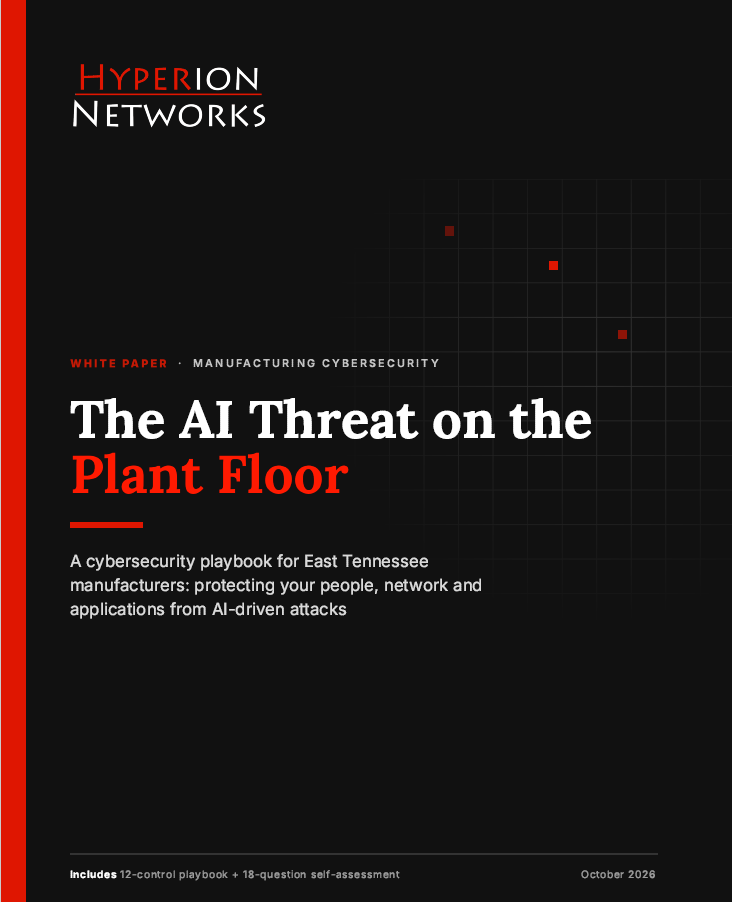
That’s why we wrote The AI Threat on the Plant Floor: A Cybersecurity Playbook for East Tennessee Manufacturers . It’s a free, plain-English guide for owners, general managers and office leads at plants with roughly 15 to 100 employees. Below is a quick look at what’s inside.
What Is the AI Threat on the Plant Floor Playbook?
The AI Threat on the Plant Floor is a free 13-page cybersecurity playbook from Hyperion Networks for East Tennessee manufacturers. It explains how AI is changing cyberattacks against people, networks and applications, shows what each threat looks like inside a working plant, and lays out 12 practical controls plus an 18-question self-assessment.
Why Manufacturers Are in the Crosshairs
Attackers go where downtime hurts most. When a production line stops, shipments slip, crews sit idle and customers start calling. That pressure is exactly what makes manufacturers pay. The research behind the playbook is blunt:
- Manufacturing has been the most-attacked industry for five years running, according to the IBM X-Force 2026 Threat Intelligence Index.
- Ransomware incidents against manufacturers rose about 40% year over year in 2026, and 70% of victims with known revenue were companies between $10 million and $100 million ( Black Kite, via SecurityWeek).
- Manufacturers hit by ransomware paid a median ransom of $1 million, with average recovery costs of $1.3 million on top of that ( Sophos).
In other words, “we’re too small to be a target” no longer holds up. The middle of the market is where attackers are focusing.
Four AI-Era Threats the Playbook Breaks Down
1. Attackers Outside Your Walls
AI now writes phishing emails that outperform skilled human attackers, and voice cloning lets criminals “confirm” fake payment requests over the phone. The FBI documented $893 million in AI-related fraud losses in 2025. The playbook walks through a realistic accounts payable scenario and the simple payment-verification rule that stops it. If executive impersonation is already on your radar, our guide on stopping executive impersonation scams is a good companion read.
2. Well-Meaning People Inside Them
Most AI risk inside a plant isn’t sabotage. It’s a good employee pasting a customer drawing, a price list or process settings into a free AI tool to save an hour. IBM found that one in five organizations traced a breach to this kind of unapproved “shadow AI,” and only 37% have a policy to manage it. The playbook shows how a one-page AI use policy and an approved tool close that gap.
3. Your Network and Production Floor
Flat networks, always-on vendor remote access and old machines that can’t be updated are how an office problem becomes a production problem. The playbook covers network segmentation, vendor access controls, 24/7 monitoring and recovery planning, plus what to ask before you add AI to equipment on the floor. For the downtime side of the story, see how to reduce IT downtime in manufacturing.
4. The Apps You Already Use
AI assistants are being switched on inside email, file sharing and ERP systems. They can read whatever a user can read, and attackers have already shown ways to trick them into leaking data. The playbook explains what to clean up before you turn these tools on and the three questions to ask every software vendor about their AI features.
Built for East Tennessee
About 62,000 people work in manufacturing across East Tennessee, and many local plants supply the defense ecosystem around Oak Ridge. If that’s you, AI use and CMMC compliance are tied together: a controlled drawing pasted into a public AI tool can put your contract eligibility at risk. The playbook covers where those two collide and points to local help from the University of Tennessee Center for Industrial Services. New to CMMC? Start with our plain-English guide to CMMC.
12 Controls, Organized by Stability, Security and Operations
Every recommendation in the playbook is grouped by the three lenses Hyperion uses with every client:
- Stability: tested backups, a production recovery plan, network segmentation and patching with deadlines.
- Security: multi-factor authentication, 24/7 endpoint monitoring, controlled vendor access and clean permissions before AI.
- Operations: an AI use policy, payment verification, AI-era training and human sign-off on AI-driven actions.
It closes with an 18-question self-assessment you can complete in about ten minutes to see where your plant stands and what to fix first.
Three Things You Can Do This Month
- Publish a one-page AI use policy that names approved tools and lists the data that never goes into AI.
- Set a payment rule: no change to a vendor’s bank details without a call-back to a number you already have on file.
- Turn on multi-factor authentication for email and every form of remote access.
Want to talk through your results? Contact Hyperion Networks and we’ll help you decide what to tackle first.
Download the Free Playbook

Get the full playbook, including all 12 controls, the plant-floor scenarios and the 18-question self-assessment. Enter your information below and we’ll send it right over.
Recent Posts