Disaster Planning for Manufacturers: Where Stability, Security, and Operations Meet

Danny Crumpton • March 17, 2026

Share this article

Everyone has a disaster plan. I've yet to walk into a manufacturing environment that didn't have one.

What we have walked into (more times than we’d like to count) is a crisis where nobody could find it. Sometimes the person who wrote it left two years ago, or the plan assumed the network would be partially working, and it wasn't. 


What we see most often is that the first hour of the crisis was spent figuring out who was supposed to be in charge, while the clock ran and the floor sat idle.


After years of responding to these situations, we can tell you with confidence: the technology is almost never the hard part. The hard part is the ten minutes immediately after something goes wrong. That window, before anyone has made a decision, before the first call gets placed, before a single action is taken, is where recoveries are won or lost.


That's what we actually help with. At Hyperion Networks, we rarely build templated “IT plans”. When you work with an IT company, plans are a bare minimum and not the entire deliverable. We build you Operational Resilience through three non-negotiable solid pillars.


Pillar 1: Stability

A plan you haven’t practiced is just a theory or a random document. The question we like to ask every manufacturing leadership team we sit down with is this: if your network went dark right now, how long before your team is executing a response and not discussing one?


Stability isn’t the absence of failure. It’s the predictability of recovery. If an incident occurs and your team has to "improvise" the solution, your environment is inherently unstable.


Let’s take a look at the first hour. When systems go down, you don't lose time because people don't care. You lose time because of decisional paralysis. 


Who owns the call to shut down the segment?

Which vendor gets called first?

What is the recovery priority: Payroll, Shipping, or Production?


What we do at Hyperion: We facilitate Tabletop Exercises. 


Beyond your back-up checks, we role-play the first hour of all your possible crises. If your team can’t answer, “What do we bring back first to get trucks moving?” you don’t have a stability plan. That is simply hoping for the best.


If your team can't answer "what do we bring back first to get trucks moving?" without hesitating, that's the thing we fix. That's the gap we prioritize closing.


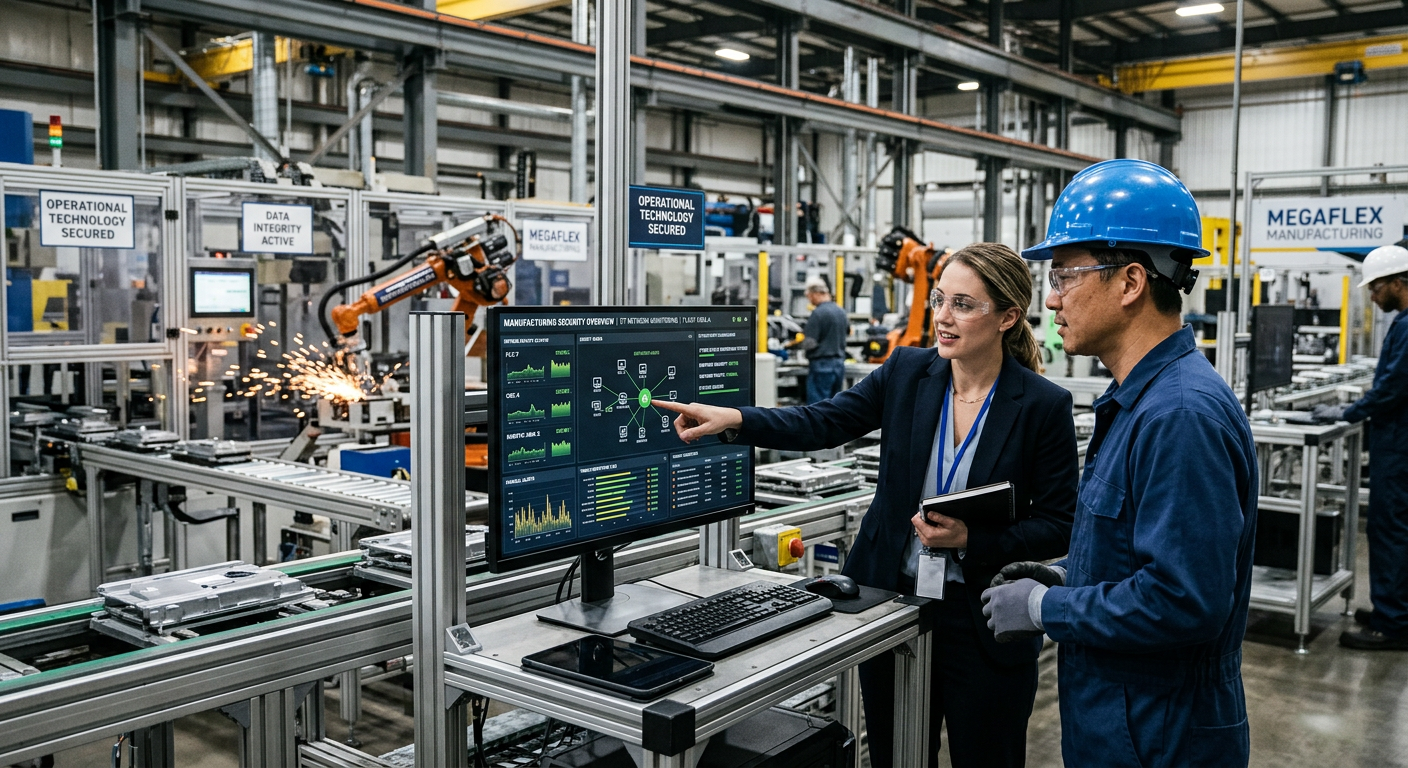
A professional and a worker in a factory setting discuss data on a computer screen placed near an assembly line.

Pillar 2: Security

Can you recover if the threat comes from the inside? 


There's one vulnerability we’ve seen in nearly every organization we've onboarded, and it's one that almost nobody catches on their own because it looks, on the surface, like responsible documentation practice.


Most companies store their disaster recovery plan in SharePoint, a company wiki, or a network-hosted drive. It is somewhere logical, organized, and completely inaccessible the moment your identity systems go offline.


Now, the question is, if your network is encrypted and your identity systems are down, can you access your recovery SOPs in under two minutes?


What we do at Hyperion:


We perform a “Glass-Break” strategy. This is executed with the following actions:


  • Immutable backups: We ensure your recovery data is "Air-Gapped" and unreachable from the compromised network.
  • Offline access: We help you build "Break-Glass" protocols. These are protected, offline references that don't depend on the environment behaving normally. 


The goal here is that your ability to recover should never depend on the thing you're trying to recover from.


Pillar 3: Operations

3-2-1 Backups are about time and not tech.


When a network goes down, IT goes to work on the restoration. That's what they're trained to do. But the plant floor doesn't stop existing while that's happening. Shifts keep running, the trucks are showing up, and your customers are expecting shipments. 


If nobody planned for the hours between "the network is down" and "the network is back," those hours become useless, and not to mention, extremely expensive.


Can shipping generate a manual bill of lading if the system is offline? Can receiving log an incoming load on paper? Can your quality team verify parts without pulling the database? Can a shift supervisor run the line for four hours without the ERP?


These aren't IT questions. But IT is usually the only team asking them (or not asking them), which is the problem.


At Hyperion, we've made it our practice to bridge that gap explicitly. Our job isn't to rewrite your floor procedures. But a technically successful recovery that leaves your plant unable to operate for half a day isn't a recovery. In fact, it's a more expensive version of the same crisis. Both sides of the business need to be moving simultaneously, and we plan for both. Recovery should never equal paralysis.


The "Hyperion Tabletop": A Simple Way to Start

If your organization isn't ready to undertake a full resilience review, we encourage you to run one simple exercise before the end of the month. It costs nothing, requires no outside help, and will tell you more about your real vulnerabilities than most formal assessments.


Get the right people in a room: IT leadership, operations, plant management. Give them one constraint: the primary network is completely inaccessible and will remain so for the next six hours. Then present three questions and listen carefully to the responses. Just listen.


  1. Access: Do we have the vendor phone numbers written down physically?
  2. Priorities: Does IT know that "Line 4" is more important than "Accounting" right now?
  3. Workarounds: Does the shift lead know how to run the plant without the ERP?


The places where people go quiet, look at each other, or start to argue…. those are your gaps. They are not hypothetical risks. They are real ones—specific to your building, your team, your operation.

The good news is they're all fixable. The only question is whether you find them in a conference room on a Tuesday, or at 2:00 AM when it actually matters.


Talk to Hyperion about building a plan your plant floor can actually use when it counts.

Recent Posts

Smart factory floor with digital cybersecurity overlays
March 17, 2026
Learn why smart factories in Tennessee struggle with cybersecurity. Discover the common mistakes in IT/OT convergence and how to secure your production line.
A vintage computer server glows red in a cluttered, dimly lit tech lab.
March 9, 2026
A 15-year-old ERP system can expose your business to security risks, downtime, and costly failures. Discover how to safely harbor legacy ERP infrastructure.
Woman in pink shirt using a laptop in a server room, with reflections in the glass.
March 3, 2026
Outdated IT can stop your production line. See how IT lifecycle management helps East Tennessee manufacturers prevent downtime and protect throughput.
Children and adult sitting in circle, raising hands in a park.
February 16, 2026
See how a unified IT strategy elevated performance for a youth non‑profit in Lenoir City by standardizing systems, improving visibility, and reducing tech friction across its multi‑site environment.
Glowing circuit path through mountainous terrain, leading to a stylized outline of Tennessee, with technology icons.
February 14, 2026
Discover the 6-step technology maturity roadmap for Tennessee manufacturers and learn how to stop chasing shiny objects by building a clear, strategic path to smarter tech adoption.
Man in suit stands before glowing blue portal in a tech-filled, industrial room.
February 13, 2026
Explore why smart manufacturers often stay silent about IT problems, the hidden costs of unresolved tech issues, and how strategic IT planning can drive long‑term growth and stability.
Industrial conveyor belt in a large warehouse.
February 13, 2026
Learn the real cost of manufacturing downtime and how a frozen shop floor can cost thousands per hour, plus strategies to reduce outages and improve operational stability.
Woman with curly hair in black sweater, leaning against a glass wall while using a laptop in an office hallway.
January 27, 2026
Explore why there’s no single “magic bullet” in IT and how Hyperion Networks embraces complexity to deliver reliable, secure, and strategic technology solutions for real business outcomes.
Person on laptop having a telehealth appointment with a doctor.
January 15, 2026
Learn how robust IT infrastructure powers real telehealth expansion beyond basic video calls — ensuring reliability, security, compliance, and seamless virtual care delivery for healthcare practices.
Forklift operator in a warehouse, lifting a stack of pallets.
December 18, 2025
Stop losing minutes to IT headaches. We helped a Powell logistics team cut support tickets by 65% and automate document flows. Get predictive stability that lets you focus on moving product.
Show More