
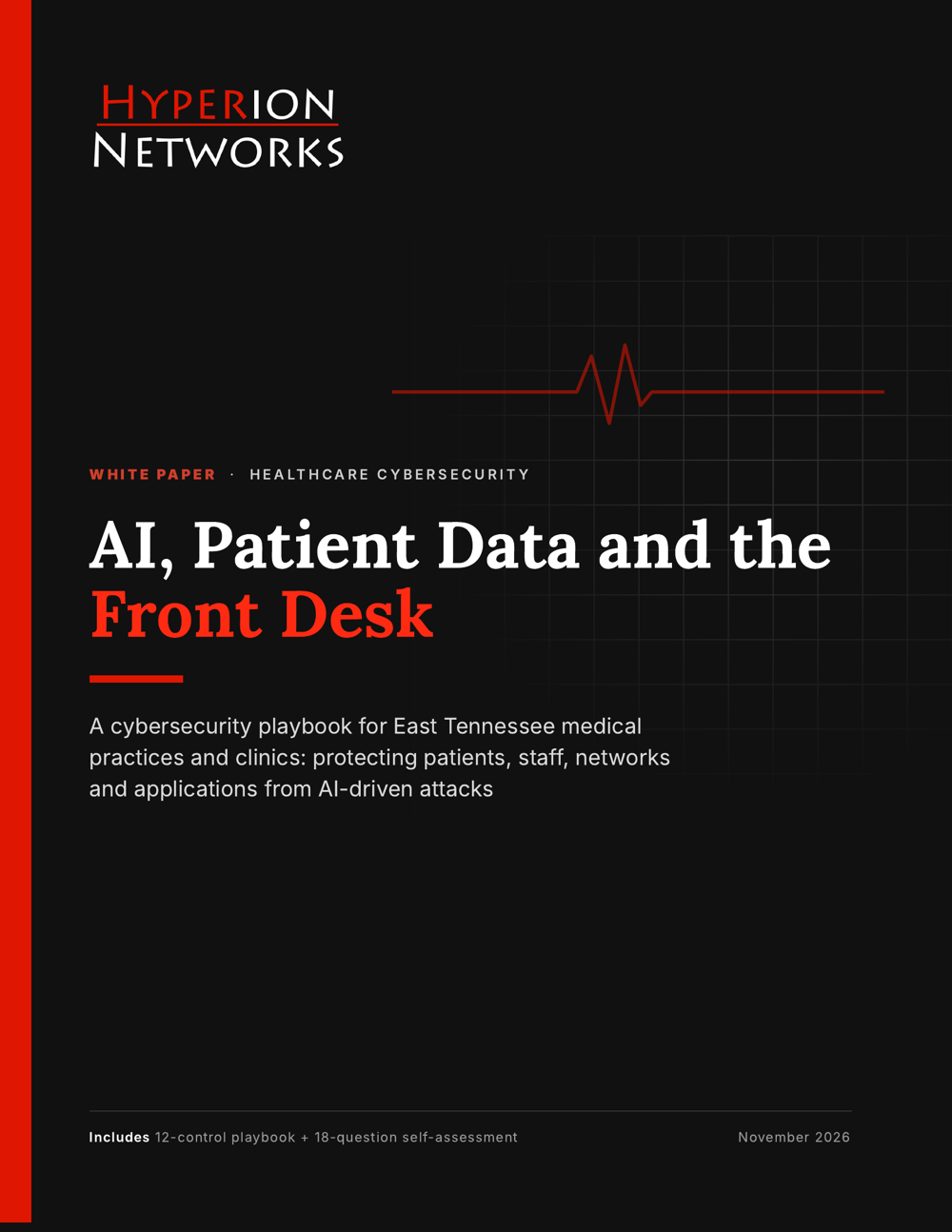

AI Is Changing How Hackers Target Medical Practices: A Free Cybersecurity Playbook for East Tennessee Clinics

Joe Ray • November 18, 2026

Share this article

Thank you for contacting us.
We’ll get back to you as soon as possible.

We got it.

The call sounds routine. Someone who sounds just like your billing coordinator says her phone broke, she can’t get her login codes, and she needs access before the clearinghouse deadline. A few minutes later, the caller is inside your systems, changing where insurance payments go and reading patient records. AI didn’t invent new ways to steal patient data. It made the old ones faster, more convincing and harder to catch. For medical practices in East Tennessee, that shift is already here.

That’s why we wrote AI, Patient Data and the Front Desk: A Cybersecurity Playbook for East Tennessee Medical Practices and Clinics . It’s a free, plain-English guide for practice owners, administrators and office managers at practices with roughly 15 to 100 employees. Here’s a quick look at what’s inside.

What Is the AI, Patient Data and the Front Desk Playbook?

AI, Patient Data and the Front Desk is a free 14-page cybersecurity playbook from Hyperion Networks for East Tennessee medical practices and clinics. It explains how AI is changing attacks against staff, networks and applications, shows what each threat looks like inside a real practice, and lays out 12 practical controls plus an 18-question self-assessment.

Why Medical Practices Are in the Crosshairs

A medical record holds names, birth dates, insurance details and often Social Security numbers in one place. And when a practice’s systems go down, patients still show up. That combination keeps attackers coming back. The research behind the playbook is clear:

  • Healthcare has been the most expensive industry for data breaches 14 years in a row, at an average of $7.42 million per breach ( IBM, via TechTarget).
  • A record 772 large healthcare breaches were reported to federal regulators in 2025, and hacking and other IT incidents caused more than 80% of them ( HIPAA Journal).
  • Healthcare organizations hit by ransomware spent an average of $1.02 million to recover, and 42% said a lack of people or capacity contributed ( Sophos).

The averages are pulled up by big hospital systems, but smaller practices aren’t spared. When security falls to whoever has time, attackers notice.

Four AI-Era Threats the Playbook Breaks Down

1. Attackers Who Sound Like Someone You Know

The U.S. Department of Health and Human Services warned that attackers have called health-sector IT help desks posing as finance staff, talked their way into new login codes, redirected payments and, in some cases, tried AI voice impersonation ( HHS alert, via Security Affairs). The playbook shows how a simple call-back rule for password resets stops this cold.

2. Well-Meaning Staff and Shadow AI

Most AI risk inside a practice isn’t malicious. It’s a front-desk coordinator pasting a patient message into a free chatbot to help write a kind reply. Nearly one in five hospital and health system workers say they’ve used an unapproved AI tool, and only 17% of administrators knew their organization’s main AI policies ( Wolters Kluwer, via Healthcare Dive). The playbook explains why that’s a HIPAA issue, not just an IT issue, and how a one-page AI policy closes the gap.

3. Your Network, Devices and Downtime

When exam-room PCs, guest Wi-Fi and medical devices share one network, a single compromised login can reach everything. The playbook covers network segmentation, 24/7 monitoring and a clinical downtime plan so you can keep seeing patients if systems go offline. For the foundation underneath all of it, see why healthcare security starts with IT stability.

4. The Apps and AI Tools You Use

AI scribes, EHR add-ons and AI assistants in email all handle protected health information. The playbook walks through what to check before rolling one out, including a signed business associate agreement, data retention and patient consent, plus the four questions to ask every vendor about their AI features.

Close to Home: The Tennessee Factor

The largest healthcare data breach ever reported started at Nashville-based Change Healthcare, where attackers used stolen credentials on a remote access portal that didn’t require multi-factor authentication. About 192.7 million people were affected ( Healthcare Dive). In 2025, a ransomware attack on Cookeville Regional Medical Center exposed the information of 337,917 people ( HIPAA Journal). The playbook covers what these incidents mean for practices in Knoxville, Maryville, Oak Ridge, Sevierville and the Tri-Cities.

HIPAA in the AI Era

Federal regulators are focused on one thing above all: an accurate, up-to-date HIPAA risk analysis. The playbook explains why every AI tool that touches patient data now belongs in that analysis, and what the proposed HIPAA Security Rule update would require, from multi-factor authentication to restoring critical systems within 72 hours.

12 Controls, Organized by Stability, Security and Operations

Every recommendation is grouped by the three lenses Hyperion uses with every client:

  • Stability: tested backups, a clinical downtime plan, network segmentation, and an asset inventory with patching deadlines.
  • Security: multi-factor authentication everywhere patient data lives, 24/7 endpoint monitoring, help desk identity verification and least-privilege access.
  • Operations: an AI use policy, an annual risk analysis that includes AI, AI-era training and a vendor and AI tool review.

It closes with an 18-question self-assessment you can finish in about ten minutes to see where your practice stands and what to fix first.

Three Things You Can Do This Month

  1. Publish a one-page AI use policy that names approved tools and makes clear patient information never goes anywhere else.
  2. Lock down password resets: no reset or new login device without a call-back to a number already on file.
  3. Turn on multi-factor authentication for the EHR, email and every form of remote access.

Download the Free Playbook

Get the full playbook, including all 12 controls, the real-world practice scenarios and the 18-question self-assessment. Enter your information below and we’ll send it right over.

[FORM PLACEHOLDER: Download form goes here. Remove this line once the form is added.]

Want to talk through your results? Learn more about our managed IT services for healthcare, see our healthcare client case studies, or contact Hyperion Networks and we’ll help you decide what to tackle first.

Download the Free Playbook

Get the full playbook, including all 12 controls, the plant-floor scenarios and the 18-question self-assessment. Enter your information below and we’ll send it right over.

This is required
Enter an email Use an address with (@) and (.)
This is required
This is required

That didn’t work.

The form wasn’t sent. Please try again.

Recent Posts

By Hyperion Networks • November 19, 2026
A Knoxville advertising agency owner needed screen reader and dictation tools that worked across Outlook, Teams and web portals. See how Hyperion set it up.

By Hyperion Networks • November 19, 2026
An Alcoa regional public organization wanted fewer on-site servers, stronger security and a real plan for AI. Here's how Hyperion took over its IT in 2026.

By Hyperion Networks • November 19, 2026
A new Knoxville pediatric practice needed Microsoft 365, secure workstations, firewall and Wi-Fi before opening. See how Hyperion built it in under a month.

Attorneys reviewing documents in a law office conference room at an East Tennessee firm
By Hyperion Networks • November 19, 2026
AI makes attacks on law and accounting firms faster and more convincing. Get our free playbook: 12 controls and a self-assessment for East Tennessee firms.

By Hyperion Networks • November 19, 2026
A Knoxville retailer's remote server failed and its backups weren't running. See how Hyperion recovered the data, audited security and simplified their IT.

Manufacturing plant floor with CNC machines and a production line in East Tennessee
By Joe Ray • October 14, 2026
AI is making attacks on manufacturers faster and harder to spot. Get our free playbook: 12 controls and a self-assessment built for East Tennessee plants.

By Hyperion Networks • May 21, 2026
CMMC explained for East Tennessee manufacturers: the three levels, the four-phase rollout, the real cost, and what defense contractors must do before Phase 2 hits in November 2026.

A modern business professional using a VoIP-enabled phone system in a professional Knoxville office.
May 21, 2026
Learn how to select the ideal VoIP system for your business in East Tennessee. Our guide covers features, costs, and local support to keep your office connected.
By Hyperion Networks • April 1, 2026
AI will not fix bad manufacturing data — it will scale it. Here is what East Tennessee manufacturers need in place before AI becomes useful on the plant floor.

Rows of black server racks in a data center with a mobile computer workstation on a concrete floor.
March 24, 2026
See how Hyperion Networks eliminated regional downtime and blind spots for a multi-office enterprise using centralized oversight and FortiManager standardization.
Show More